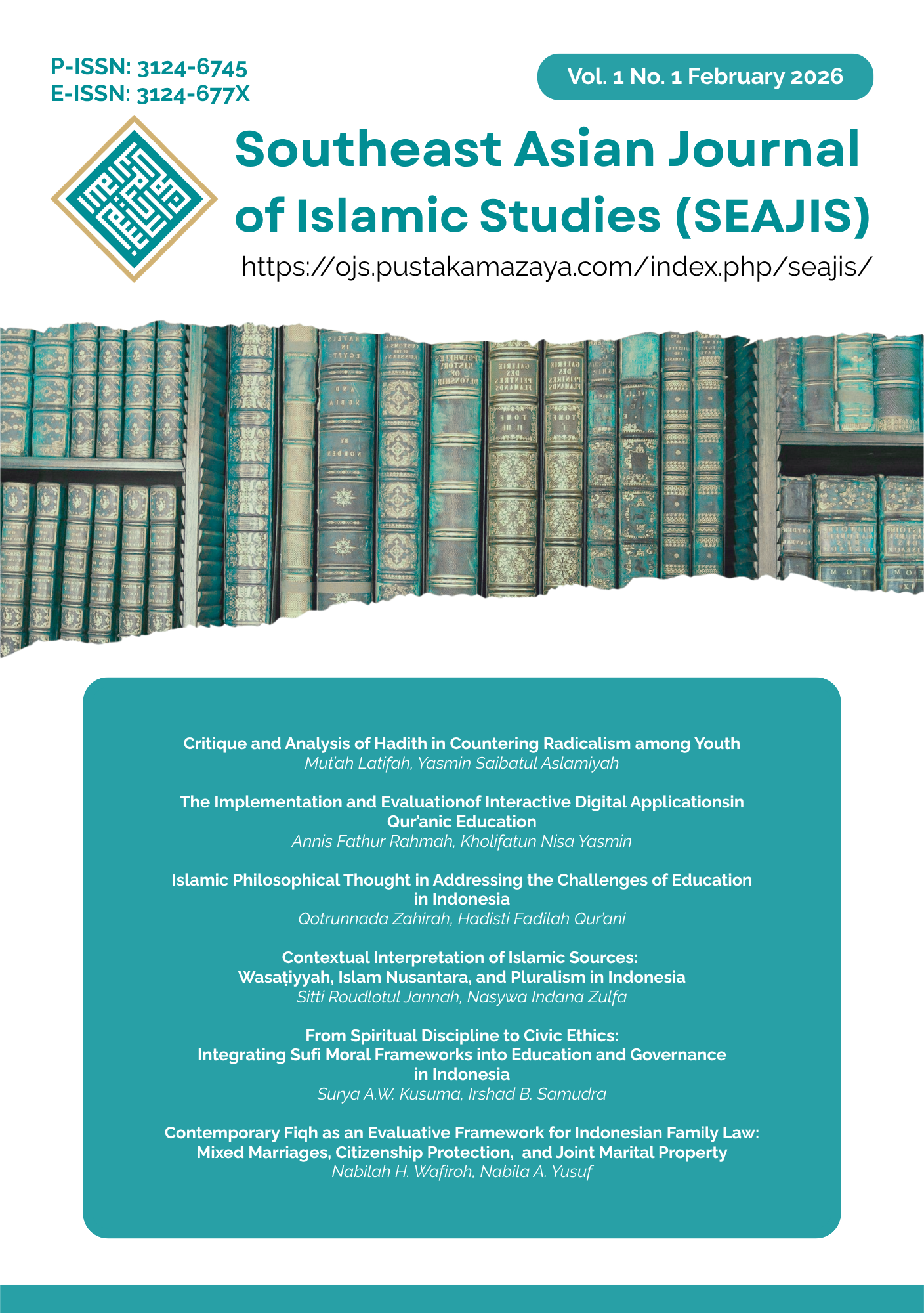
From Spiritual Discipline to Civic Ethics
Integrating Sufi Moral Frameworksinto Education and Governance in Indonesia
DOI:
https://doi.org/10.66127/0mzxay29Keywords:
Sufism, moral education, civic ethics, spiritualityAbstract
Indonesia faces persistent moral challenges, including youth violence, online incivility, and corruption, which demand frameworks for value formation that are both context-sensitive and spiritually grounded. This article reinterprets the classical Sufi triad of takhallī (purification of vices), taḥallī (cultivation of virtues), and tajallī (divine manifestation) as mechanisms that can be operationalized for contemporary moral education and civic ethics. Methodologically, the study employs an integrative literature review combined with hermeneutic–thematic analysis of canonical Sufi texts and empirical studies on spirituality, psychology, and education. Findings indicate that takhallī aligns with self-regulation training to inhibit aggression and foster emotional control; taḥallī maps onto prosocial character formation through service-learning, ethical laboratories, and reflective governance practices; and tajallī fosters meaning-making and social cohesion through communal rituals and civic engagement. The study contributes academically by reframing Sufi ethics as intervention-ready, bridging classical Islamic spirituality with global scholarship on moral development, and practically by offering design principles for embedding Sufi-based interventions into schools, public service, and community programs. These insights suggest that tasawwuf akhlāqī remains a living resource for nurturing virtuous individuals, ethical institutions, and cohesive societies in Indonesia today.
Downloads
References
Abdullah, N. (2024). The Role of Aqidah and Moral Teachers in Instilling Sufi Values in Students at SMA Muhammadiyah 5 Yogyakarta. Journal of Islamic Education and Ethics, 2(1), 35–43. https://doi.org/10.18196/jiee.v2i1.27
al-Ghazālī. (2011). Iḥyā’ ‘ulūm al-dīn. Beirut: Dār al-Ma‘rifah.
Bozorgzadeh, S., & Grasser, L. R. (2022). The integration of the heart-centered paradigm of Sufi psychology in contemporary psychotherapy practice. Psychotherapy, 59(3), 405–414. https://doi.org/10.1037/pst0000414
Cetinkaya, M., & Billings, J. (2023). Systematic review of the relationship between Islamic-Sufi spirituality and practice and mental well-being. Mental Health, Religion & Culture, 26(10), 1065–1080. https://doi.org/10.1080/13674676.2023.2256265
Fahrudin, F., Islamy, M., Faqihuddin, A., Parhan, M., & Kamaludin, K. (2024). The Implications of Sufism Akhlaqi to Strengthen The Noble Morals of Indonesian Students. el Harakah: Jurnal Budaya Islam, 26(1), 74-93. https://doi.org/10.18860/eh.v26i1.26192
Gurbuz-Dogan, R. N., & Ali, A. (2025). Sufi music with makams for people with mild to moderate levels of depression and anxiety: A pilot feasibility randomised controlled trial. Transcultural psychiatry, 13634615251357470. Advance online publication. https://doi.org/10.1177/13634615251357470
Hamsyah, F., & Subandi. (2016). Dzikir and Happiness: A Mental Health Study on An Indonesian Muslim Sufi Group. Journal of Spirituality in Mental Health, 19(1), 80–94. https://doi.org/10.1080/19349637.2016.1193404
Koenig, H. G., Religion, Spirituality, and Health: The Research and Clinical Implications, International Scholarly Research Notices, 2012, 278730, 33 pages, 2012. https://doi.org/10.5402/2012/278730
Lickona, T. (1991). Educating for character: How our schools can teach respect and responsibility. New York: Bantam Books.
Park, N., Peterson, C., & Seligman, M. E. P. (2006). Character strengths in fifty-four nations and the fifty US states. The Journal of Positive Psychology, 1(3), 118–129. https://doi.org/10.1080/17439760600619567
Purwanto, Y., Saepudin, A., Shofaussamawati, , Islamy, M. R. F., & Baharuddin, D. (2023). Tasawwuf moderation in higher education: Empirical study of Al-Ghazālī’s Tasawwuf contribution to intellectual society. Cogent Social Sciences, 9(1). https://doi.org/10.1080/23311886.2023.2192556
Rahmah, R., Saleh, H, A & Rahmi, N, S. (2024). The Influence of Sufism on Social Practices in Contemporary Muslim Societies: A Case Study in Indonesia. Journal of Noesantara Islamic Studies, 1(4), 214-232. https://doi.org/10.70177/ijnis.v1i4.1396
Schnell, T. (2009). The Sources of Meaning and Meaning in Life Questionnaire (SoMe): Relations to demographics and well-being. Journal of Positive Psychology, 4(6), 483–499. https://doi.org/10.1080/17439760903271074
Tangney, J. P., Baumeister, R. F., & Boone, A. L. (2004). High self-control predicts good adjustment, less pathology, better grades, and interpersonal success. Journal of Personality, 72(2), 271–324. https://doi.org/10.1111/j.0022-3506.2004.00263.x
Treviño, L. K., Weaver, G. R., & Reynolds, S. J. (2006). Behavioral ethics in organizations: A review. Journal of Management, 32(6), 951–990. https://doi.org/10.1177/0149206306294258
Downloads
Published
Issue
Section
License
Copyright (c) 2026 Southeast Asian Journal of Islamic Studies

This work is licensed under a Creative Commons Attribution-ShareAlike 4.0 International License.